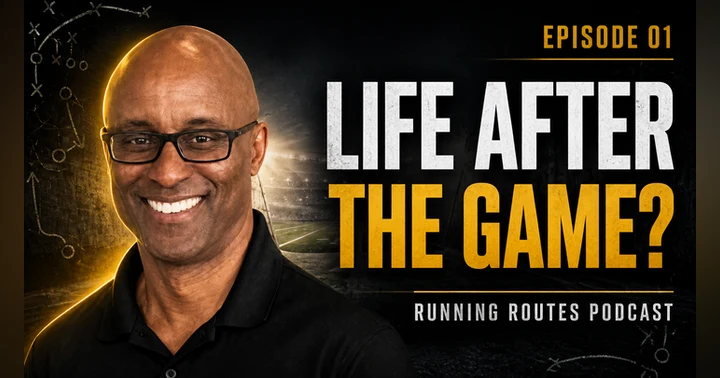
Episode 02: High Achievers Are You Using the Wrong Scoreboard for Success

The Biggest Mistake High Achievers Make: Using the Wrong Scoreboard for Success
The Confusion of the Wrong Game
Imagine this. You're walking off to the field after a great game. You had 135 yards receiving. You had nine catches. You had 50-something yards of yak. You scored two touchdowns. You blocked a punt.
What a great game. But as you walk off the field, you look up at the scoreboard and you realize that your team lost to the other team because the other team hit a grand slam home run and a walk-off home run in the bottom of the ninth to win the game by two runs.
You'd be a little confused, wouldn't you? But for many of us high achievers, what we do is we're still keeping track, keeping score, but we're using the wrong scoreboard for success. Today we're going to talk about how to get to using the right scoreboard.
Hello, my name is Alan DeGrafenreed, and this is the Running Routes Podcast. As I said today, we're going to talk about why are we overachievers and high achievers constantly keeping score but not paying attention to what's going on?
What we are going to today is tell you my background, my athletic background, what I did as an athlete. Gonna go through that and then I'll pivot into the message of the day, which is how are we scoring ourselves? What are we going by in our lives?
My Journey: From Benchwarmer to the Viking Cup
So for me, I'm from Cincinnati, Ohio. I went to Princeton High School. Through middle school, I really was not a standout athlete. I was just kind of a guy out there.
When I got to ninth grade, I was on the soccer team. I didn't quite make varsity, but I played a lot of varsity minutes, let's just say. I was on the soccer team, ran track, played basketball, sat at the bench in basketball, probably paid a total of five minutes the entire season.
Just really wasn't my sport, and I knew it. My sophomore year though, things started to turn around for me. I can remember standing in the hallway and Harlan Barnett, HB's walking down the hallway, and everybody's celebrating HB.
They're talking about Harlan, Harlan, Harlan, this different stuff. And I said, What's the deal? What's up with Harlan? Somebody said, he just won the Viking Cup.
And I said, Well, what's the Viking Cup? And they said, that's the award that's given to the best athlete in the school in his senior year. And I looked at my buddies and I said, I'm gonna win the Viking Cup.
And they laughed and giggled and they said, There's no way you can win the Viking Cup. You're on the soccer team, nobody cares about soccer. You're on the basketball team, but you just sit the bench and in track, you run the 800.
No one cares about the 800, and you're honestly not that good at it. And I said, I don't care what you guys say, I'm going to win the Viking Cup. So that begins my journey.
Earning the Scholarship at Ohio State
So again, freshman year wasn't so great. Sophomore year though, ha. I started on the varsity soccer team, scored a lot of goals. I don't think I scored the most, but I scored like eight or nine goals, which was high for us at the time.
I then went into basketball season. I gave up basketball and I focused on track. And in track, I ran the 800 and the 400. 800, if you don't know, is twice around the track. The 400 is once around the track. And I also ran the mile, but that was not as much.
So my sophomore year, I just start lighting up and track. And by the end of the season, one of the guys on our four by 800 meter relay gets sick, and I get the opportunity to run for our team to win the state championship.
I have to break two minutes in the 800 in order to do this. And so I start putting in the work. I stop playing soccer on the side, and we do actually win the state championship in a four by eight hundred meter relay.
Me, Julian Wagner, Larry Matthews and of course Tyron Olverson, who's the king of kings when it comes to 800 at Princeton High School. So we win the four by 800 meter relay. And now I'm all of a sudden I'm one of the top athletes in the school.
And I'm like, whoa, this is kind of cool. And so from there, I become a standout athlete. My junior year, I go on and play soccer, go to state again and track. My senior year, my junior year, I also decided to join the football team.
I didn't play any positions, I was the kicker. I was the guy that did the kickoffs, my junior year. Kicked the ball off. Wherever they wanted kick it, I kick it they go tackle the guy.
If they didn't want to tackle anybody, it's kicked out back of the end zone, whatever they wanted me to do. Then my senior year as a kicker, I ended up winning the award. Ended up being the first team All-State kicker, which was a big deal.
And for some reason, I was up for all these different awards around the city. The That's My Boy Award, some kind of collegiate NCAA award. I had all these different awards I was up for.
I'm not sure exactly why. So I was not the star of the show. I was just a guy that got a lot of media play. And also we won state. So we won the state championship in football my senior year.
Couple of notes. The record for the four by 800 meter relay has never been broken. We did that way back in the 80s. Also, my state football team, no one's won state at that school since then, although they're very good this year. Congratulations on beating Mole the other day, guys.
So that's there. So we're gonna end the senior year. And I'm doing my thing and I'm getting a lot of media play. I'm in the news about a different stuff, this award, that award, the other award, and all of a sudden I'm a standout athlete.
And lo and behold, guess what happens? I win the Viking Cup. So first team all-state kicker, I win the Viking Cup. So it made perfect sense to me to say, hey, I think I'll walk on and be a kicker for the Ohio State Buckeyes.
That's the biggest goal in the state. I'll walk on, I'll be a kicker and everything will be great. I'll be the first black kicker and I'll I'll get on TV. This is gonna be awesome.
The Long Shot: Making the NFL with Eight Catches
What happened my spring is once again went back to state in the 4-bate hundred meter relay, anchored the relay, wore these funky red socks, right? And we ended up taking second. 100% my fault.
Apologies to the guys, Gordon or GB, Joseph, and Jeff. I'll be apologizing to the day I leave this earth. But anyway, we lose the race. But what I didn't realize was that Ron Zook, the secondary coach for the House State Buckeyes, was in the stands watching the race.
And when I got on the podium, they announced my name. And so Zook looks at the guy next to him and says, Hey, we got a kid coming to kick to what for us that from Princeton named Alan DeGrafnery.
They said, Yeah, that's the same kid. And he says, The kid runs like that and he doesn't play football? What are we talking about here? And they said, I think he plays soccer and he just kicks the football.
So I get a call that summer and they say, Hey, Alan. Would you like to come and play wide receiver for us? And I'm like, sure, that'll be fun. At the time they didn't take any time to ask me, Alan, do you know anything about catching the ball? No.
Anything about blocking? No. Routes, route trees. What's it cover coverage? You know, coverage? No, I knew none of this stuff. And I show up at Ohio State, 155 pounds soaking wet.
I'm going through meetings at Ohio State, and it's are you kidding me? Type of thing. It's like I have no idea what they're talking about. One day they're talking about cover two, the next time it's three, then it goes to four, then it jumps all the way to seven, then it jumps all the way to 25.
And I'm like, what are we talking about here? And I'm just totally lost out there being a misfit. So I'm in my freshman year at Ohio State and I'm running routes the best I can.
I'm just following the cue cards, doing what I could do. And for three years, that's what I did. I don't want to get into all what those three years were about.
I just want to kind of tell you the results of my time at Ohio State. So as I said, I walked on there. I was 155 pounds. I was doing sets 135 when I could. And three years later, I earned a full right scholarship to play football for the Buckeyes.
I like to point out to people that I earned my scholarship going against Vinny Clark and and guys like that that were first round, Marlon Kerner, third round pick, versus the guys that earned their scholarships in high school kids. I just like to point that out to people.
Earned a scholarship, got a full ride scholarship, play football for the Buckeyes, continue to get bigger, faster, stronger. I did become a starter. I started for I started at wide receiver at wide receiver U. And we had some ballers. We had some ballers back then too, just like they do now.
So I started wide receiver at wide receiver U. I went from 155 pounds. By the time I left, I weigh 205 pounds. So I I made some changes, right? So I'm in my senior year and I've been through some great coaches.
I had Coach Huey for three years, who went on and coached with the Colts. I had Coach Sullivan who went on and coached with the Lions, and then Coach Stock, Mike Stock, was my coach my senior year.
He had just come to us from the Cincinnati Bengals. And late in the season, going into like November, I make this catch on the sideline against this guy, and I body him out, make the catch, toe touch out of bounds.
And he walks to me, he says, that's going to really be effective next year when you're in camp. And I look at him, I said, Coach, I thought you knew I'm a senior. He says, Yeah, you're a senior.
I said, Well, how am I going to play next year? He says, He says, in the NFL. Aren't you going to the NFL? And I said, I I never thought about it. He said, with your size, speed, hands, he said, you can easily make a roster in the NFL.
And I had never thought about that. So I started obsessing about becoming an NFL wide receiver. And I started do the work. So the season ends. And I announced that I'm gonna pursue a career in the NFL.
Now, between rolling on the floor laughing at me, a lot of the people are just like, How on earth can a guy that had eight catches in his entire career here at Ohio State? That's right, I had eight catches, I had one catch my sophomore year, one catch my junior year, and six catches my senior year at Ohio State.
And they look at me and say, how can a guy with eight catches in his career at Ohio State make it to the NFL? It reminded me back to the guys that said, Alan, you can't win the Viking Cup. Alan, you're gonna walk on Ohio State to play football.
You've never played football. You'll be home, you know, be you'll be home by Thanksgiving break, having failed. It just it played back in my head again. And I'm like, I keep doing these things and you keep saying I can't do it. So what did I do? I went to work.
Life in the League: Bengals, Chiefs, and the World League
Come January for three months, I did two a days. Every day I would, not every day, but I would get up, I would condition the lift early. I would stretch and sprint at in the afternoon.
I would work on my starts, all those different things. I did that for three months, right? And when the scouts came to our pro day, because I was not invited to the combine, obviously, with eight catches, but when the scouts came to our combine, I ran a 438 40 yard dash.
I weighed 205 pounds and I bench pressed 225 19 times as a wide receiver. So I did more than some of my teammates that played other positions that weren't wide receiver. So I'd done the work.
Ohio State put me in the right direction, put me in the right place. Coach Kennedy, all my receiver coaches, Coach Cooper, they made it possible for me to do what I did. But when it came time to do it, it was me that did it.
The draft came, the draft went. I was picked up the next day by the Cincinnati Bengals as a free agent. I was with the Bengals, you know, for the better part of the season, through January.
It was funny because I was a practice squad guy. So I go out and practice every day and I'd have guys that they would ask me, is the league what you thought it was gonna be? And I'm like, man, the league is it just wasn't what I it was gonna be.
I thought it was gonna be this, not so much a party all the time, but just a little more oomph, you know. Of course I was playing for the Bengals, and at the time the Bengals were struggling. We were one and nine.
And they finally decided to put me in the game. So we I played in the tenth game of the season and we beat the Raiders. So my first game for the team, actually won. So we were one and nine.
Then we lost a couple more. I think we were one eleven. And they let me go. They released me. And when they released me, I got picked up by the Kansas City Chiefs, went to Kansas City.
So I went from a team that was one and eleven, maybe one and nine, one and ten, one and eleven, to the Kansas City Chiefs. Now I'm playing alongside Joe Montana, Marcus Allen, Derek Thomas, Neil Smith, Will Shields, JJ Burden, who just wrote a book.
If you haven't read his book, get his book. Willie Davis, you know. I mean, we it's just it's day and night. Marty Schottenheimer is the head coach. It's just, just it's just day and night different.
Real quick story. I first get to Kansas City and I'm walking back, and Darren, which I can't think I I'll think of Darren's name here in a minute. Darren's the equipment manager takes back to my locker.
He's excited to meet me. He's like, I'm a big Buckeyes fan. And we got a coach here that who did a lot of things with the Buckeyes back in the day. And walked back to my locker and I look in my locker and there's like seven or eight pairs of cleats.
There's like turf, two pairs of turfs, and there's sneakers and there's molded cleats and there's screwing cleats and there's all these different cleats. And I look at them, I said, Hey man, this this this can't be my locker, this isn't my locker.
Whose locker is this? He says, It's your locker. I said, What's up with all the shoes? He said, those your shoes. I said, Hey man, I'm not making enough money to pay for all these shoes.
I'm not paying for the shoes, man. Just take the shoes out of my locker. I'm not paying for the shoes. He's What are you talking about? I Come on, man. Why you why are you doing me like this, man? You know, I I can't afford the shoes, man.
Just take the shoes out of my locker. I got some shoes I brought with me. They're not that great. He looks at he says, Alan, calm down. This is the Kansas City Chiefs. We're owned by Lamar Hunt.
Those shoes are yours. We're giving you those shoes to wear in the games and in practice because we want you to be the best you can be. And I was like, It's it's like a wake up moment. Like you've you've been in one place, and that's not to knock the bingles, it's just a different place.
And you go over here and these these people are just so it was just so different, I could say. And when you think about the NFL, there's a lot of different levels to what's going on out there. I'm sure it's not as different as it used to be, but it's just a lot of different a lot of different rules going around.
But that's just a quick story. I'm still Darren something with the K. But yeah. Just a quick story. I'll do that from time to time. So anyway, I'm with the Chiefs. AFC championship game. We end up losing to the Buffalo Bills who go on and lose to the Cowboys.
But so anyway, time to get back to my career. Spent the better part of two years with the Chiefs. Came back that next year. And then the year after that, 1995, they sent me to to the World League.
So I got to go to Scotland, got to visit Europe. Shout out to Scotty Scoops Cooper, Yo Murphy, all the guys, George Kate, Coghill, all those guys, had a great time over there. And got to see all of Europe.
We went, there were six teams. You got to visit five different cities, plus you had five home games as well. Was a great time, great opportunity for me. Came back to Kansas City, was actually released at the end of camp.
I just got married, so we came back back to Cincinnati. The next spring, I signed with the Green Bay Packers, moved to Green Bay, was living in a hotel, getting training, training, training.
Well, had a great time in Green Bay, really small town. And that was actually the year they won the Super Bowl. They won the Super Bowl. I was not on the team anymore. They decided to let me go and kept some guy named Desmond Howard.
I don't know if you guys ever heard of him. I'm not sure why they kept him. Well, maybe it was because he took the kickoff back for a touchdown to win the Super Bowl for him, but I don't know.
Maybe, maybe, maybe it was some other reason. I'm not sure. But anyway, so got let go there. And then from there I went back to the World League in ninety seven. I was with Yo Murphy and some of those guys that second time around.
I had a really good time. Much better team, had a much better record. Really great coach. So yeah, really good time. Really good times in in Scotland both times. Second time is probably better we're in Glasgow.
And then after that I signed with the San Francisco 49ers, which was amazing to be in the huddle with Steve Young and in the huddle with like Jerry Rice, who's the greatest, who's I mean, just the way his work ethic was was was phenomenal.
That the guy that's out here, he's the best guy here and he's outworking everybody else. It's frightening how hard that man worked. But he's he was amazing. It was amazing to learn.
But after that, you know, I'd been five camps. I had not really worked out for me. So I decided that time I was gonna go ahead and quit playing football. So that brings us to the next question of what are we going to talk about now?
The Reality of Professional Transitions
So yeah, made the decision to give up football, step away from football. And that's really what I want to talk about today is really the transition from being Alan the football player to being Alan a guy that's just a guy, a former football player, right?
And for many of us, I know we struggle, and I I know that here I'm talking about me in football, but if you've been one day you were married and now you're divorced, if you were one day you're married, now you're widowed or widowered, there's all kinds of transitions we go through in life.
And how do we make that transition as smoothly as is possible is really what I'm here to talk about. I know for a lot of us that are athletes, former athletes, especially professional, it is challenging because sometimes you were in the eye of the of you everyone saw you all the time.
And so you walk into a room and people walking up to you to say, hey, it's you, can I get autographs, that type of thing. And then there comes a time when you walk into a room and people don't even know who you are, what you've done.
And so that's it can be frustrating, but it's just very much a big change. So when I played football made a point to never ever think of what was gonna happen next.
I was living a dreamy life, I was making good money, I was seeing the world playing football. And and why would I think about anything else? Well, that's what you're supposed to do.
And I tell you, it's difficult for me to sit here and tell young guys, make a plan, make a plan, make a plan. Because I know in my soul of souls, I always thought as soon as I start thinking about the next thing, the next thing's gonna come sooner.
Maybe I'm not gonna give as much effort on the field or something's gonna go wrong. So that was difficult for me to do. Like I said, if these young guys can do it now, that's great.
And I know they're making money in college. So hopefully that changes things for them as well. That's kind of a fixed amount of money for at least four or five years.
And a lot of guys get guaranteed money now, too. So that's a little different than it was back in my day. But I'll tell you, once I left football, it was probably two.
Maybe three months just solid on the couch. Just what am I gonna do next? Well, my my first challenge was did I really accomplish enough?
Which is strange, you think a guy with my background makes the leak, he should be fine with that. But in my mind, I was like remembering back to all the people in high school and before that said, You're not gonna make it.
And then my mind I could, Well, did I make it? Didn't I make it? Is what I did enough? Do I need to figure out how to get back in shape and go back and get back into football?
And so I really struggle with that. And I still struggle a little bit with that, to be honest with you. But I struggled with that, especially when I first came out of football.
And then my wife was like, baby, I mean, we I know you got money in the bank, but we need to, you need to find something, you need to do something, you need to get a job or something.
The Sales Trap: Chasing New Trophies
Luckily for me, I found a job. And in an effort to try to find something else to feed that competitive edge, I got into sales. So I went into sales, I was in financial services, and I was good at it.
I mean, I went right to the top of the board. I was a top dog in my office. I was a top dog in the region. I was winning trips to Vegas.
I was winning trips to all these different trips and things of that nature because I was good at it. And I was competitive and I was winning. And it felt good.
Didn't feel as good as the NFL, but it did feel good. And their money, the money was good. Never, never really great, but the money was good.
So for me, I think I took the am I making it and moved it over to I'll just come in here and compete and I'll win a bunch of awards or I get a bunch of promotions.
And that's I mean honest, that's that's still what I do to this day. Is I'm and I don't know if that's yours what you do, but for me, I took basically you think about my life.
I said, okay, first thing I'm gonna do is gonna walk on Ohio State, I'm gonna earn the scholarship, I'm gonna become a starter, I'm gonna make it to the NFL. And boom, boom, boom, same.
And then I just changed that into I'm going to take this job, I'm be top salesperson in the office, I'm going to get all the promotions, win all the awards.
And it was the exact same thing all over again in an effort to prove my worthiness to these people that probably were paying no attention to me.
But in my mind, everybody's watching me. Everybody's wanting to see what I'm going to do next. Am I going to rise or am I going to fall?
Am I going to fail or am I going to succeed? And in my mind, and I don't know if that's how it is for you overachievers out there, but for me, it was just trying to figure out how to win, win, win, win, win.
When in reality, I'm trying to keep the wrong score. I'm not thinking, you know, that, my daughter's at home and I haven't seen her a week because I'm working 80 hours a week.
I'm not spending time with my brand new 10, 12 month old daughter. Instead I'm over here chasing this, these people on these phones trying to get them to invest with me, right?
So it brings me to time I was at Merrill Lynch. I was a financial advisor. And once again, someone was telling me I couldn't do something.
They were telling me that, hey, there hasn't been a black finance consultant here since in the last 20, maybe 25 years. You're not gonna make it.
No one wants to invest with the brother. You can't just to get investments from the brothers to be successful. They're just telling me it's just it's not gonna work out.
You're not gonna make it. So what did I do? Did what I always do. I went to work. I was a guy that turned the lights on every morning. I was damn near the guy that turned the lights off every night.
Except I would go home to see my ten month old daughter when I could. So for me it was the same thing. Compete, compete, compete to win.
Thought I was doing really well. And then the dot com bubble started to burst. It started to sizzle. Things were getting things were going sideways. And in my mind I'm thinking, I need to find a way to get out of here.
But at the same time, as a competitor, I'm trying to find a way to win. How to get to this. I think I was trying to get to five million dollars in assets under management.
Which ended up being a lot more money than I thought it was going to be. As I worked towards that goal though, I was having a conversation with the guy and I wasn't necessarily having the greatest day.
And he walks up and he says, Hey you guys, what do you call the finance consultant at Merrill Lynch that's making a hundred thousand dollars?
And I said, I don't know what do you call him? He said, a failure. And I'm sitting there making sixty-five thousand dollars a year thinking, Yeah, maybe this isn't something I wanna do.
Cause the hours were already killing me. And I'm only managing, I'm not even managing five million dollars. It's like, So it took a little bit out of my chest, put the battery out of my back, and I it it helped me to realize there was just something else I needed to do.
I needed to pivot, do something different. But that really more than anything else brings me to the point I wanna talk about today.
Playbooks vs. Systems: Finding a New Way to Win
I think at some levels, the Maryland story just kind of tells you where it all started for me. From there, I was in and out of positions, in and out of fields.
Most of the fields I went into, some kind of major catastrophe happened. I was a mortgage guy when the when the mortgage bubble burst.
I was in finance, I was in education when the education bubble burst. So I was in a lot of places when bubbles burst, and that's that's not as as something I can control.
It wasn't something that was controllable for me. However, when I think about my life, my jobs or career, whatever you want to call it.
I think I compare it to my high school, college, and the league. In high school, I was just working to move up, up, up, and college, it was again boom, boom, boom.
And for a lot of us high achievers, we're still trying to keep score based on like I did back in the day. How often is my name in the paper?
How often am I on TV? How many stats that I make? And we're still trying to control or manage our lives using that same old system.
And what we need to realize is that old system is outdated. And as we get older, it's not effective. Because once you get to your 40s and 50s, you can't outwork that 26-year-old kid that just came out of college and he's hungry because he's trying to get married.
He's trying to get kids. You can't outwork that kid. So you've got to find a way to pivot and do something different. And so the system you're using is not the right system.
So really quick question. So when I was with the Bengals, we had a playbook. And the playbook had plays in it, right? There were just plays.
It was like you just take memorize this play, then you memorize this play, memorize this play. It was outdated. The offense we were running was outdated.
What I mean by that is probably five, six years earlier, that's the same offense that won the Super Bowl for the New York Giants. But now we're using that offense five, six years later.
And that offense is antiquated. It's not as effective, right? So then I go to the Kansas City Chiefs. Who are using the West Coast offense?
West Coast offense in the was 80s and 90s was the hottest offense out there. The great thing about the West Coast offense was that it was a system.
The quarterback could say the same number of words and mean two totally different plays, but everybody knew the difference positions and got to the right places.
And it was a system. So you plugged yourself into that system. And once you knew that system, I could sign with any team that played the West Coast offense, and I knew the system because I knew how it worked, right?
So system was the key. Over here with the Bengals, it was a group of plays, it was a playbook. In Kansas City, it was a system, right?
And so a lot of us when we think about our lives and we talk about the scoreboard, wrong scoreboard, a lot of us are using a playbook and the playbook we're using is outdated.
And what we need to do is identify a new playbook that can get us to our new levels because maybe at our age, maybe our physical standing is different, maybe we're not doing the things we used to do.
Some of the things we aren't doing now is because we we can't do them anymore, because we aren't at that age to be able to do those things.
But we have we're we're using an antiquated system to try and be successful in a different world, right? The reason I bring this up is because I found a lot of us as high achievers, we're just trapped.
We're trapped because we're trying to do the I'm still doing the same workout from 30 years ago, thinking I'm gonna get the same results. And I'm just not. I know I'm not.
But I I just do that because I love doing those same exercises over and over. But in reality, I'm not ever gonna look like I did when I was 26 years old.
Just not gonna happen. But I'm still using that antiquated old school system. So what I actually need to do is I need to find a new system.
So the reason I bring this up is because I've over the years, like I said, I've gone up and down, up and down, but I've developed different systems that have allowed me to become better.
Like if I go into a rut, I have a specific system I plug myself into, and that system brings me out of that rut. And what I'm looking to do with you all is to share my system with you.
The Running Routes podcast was mostly created to come out here and talk to people that are high achievers, talk to you about where you were, where you are, how you've gotten here, what have your struggles been, but at the same time say, if you're still struggling, hey, here's a way to get out of it.
And I've developed a full blown system. I'm gonna be presenting at the next podcast. So when I think about my journey, the ups and downs, the ins and outs, the successes, the failures, the thing that I think of is I wish someone somewhere at some time would have given me a system, some kind of something I could just plug myself into that would give me the ability to get out of the rut and move on to the next level of my life, be it because I'm older, whatever reason it might be, to get me going back to where I used to be or used to feel like I used to feel, right?
So what I've done is in the last probably 15, 20 years, I've developed a few systems. And these systems are the systems I knew I can use right now if I want to click out of a rut.
If I find myself being down for too long a period of time, I know exactly what to plug in to make sure that I can bounce back to where I want to be.
A lot of times I get hung up in life, and a lot of times I'll stay in a route because I'm just comfortable in the route. It's like the wobby.
But if you're in the wobby and the route you're way too comfortable, you're not excited about life anymore. The system I'm gonna talk to you about next week is a system you really want to consider, right?
Next Steps: The Running Routes Index
Tune in next time. I'm going talk about this system and an opportunity that you can take advantage of right now is you can go into the notes below, click the button.
It's called the Running Routes Index. Gives you an opportunity to start figuring out what's going on in your current situation.
Start to measure what's going on in your current situation so that we can start getting you out of the rut you're in. So as I always say before I check out, legacy is not what you did. It's who you helped along the way. Have a great day. See you next episode. Peace.
---
Are you ready to stop using the wrong scoreboard for success and start winning the right game?
[Click here to take the Running Routes Index and find your path back to the top.](https://example.com/running-routes-index)